
SEMEA-TEC (Sowing Technological Solutions in Family Agriculture) is a university extension project at UNIFESP — São José dos Campos campus (ICT) — working at the intersection of computing, electronics, rural extension and participatory methodologies. Our purpose is to develop low-cost, low-energy social technologies for family agriculture, tackling the digital exclusion that deepens historical inequalities in the countryside.
The project is organically linked to my doctoral research at PPGIT/UNIFESP: while the extension operates as a living laboratory of listening and co-creation with communities, the PhD investigates the technical-scientific foundations for these systems to reach maximum energy autonomy — with batteries that harvest energy from the environment, based on non-toxic, low-impact materials — and economic viability at scale.
How we work
We adopt Action Design Research (ADR) as our central methodology: before any line of code or solder, we go to the field with partner organizations for active listening and participatory diagnosis of real needs. Only then do we move to co-creating prototypes, testing on the properties and iterative improvement cycles. Farmers sit at the center of the debate — not as passive beneficiaries, but as co-producers of the innovation.
Our theoretical foundation rests on the Epistemologies of the South (Boaventura de Sousa Santos), Social Technology (Dagnino, Thomas) and a commitment to a just ecological transition, aligning the work with SDGs 1, 4, 7, 9 and 13.
Two rounds already completed
JavAlarm — electric fence monitoring over LoRa
The first cycle emerged from observing an established practice in the territory: family farmers in the Paraíba Valley use electric fences against invaders, especially wild boars (Sus scrofa), and often only discover a fence failure days later, when the damage is done.
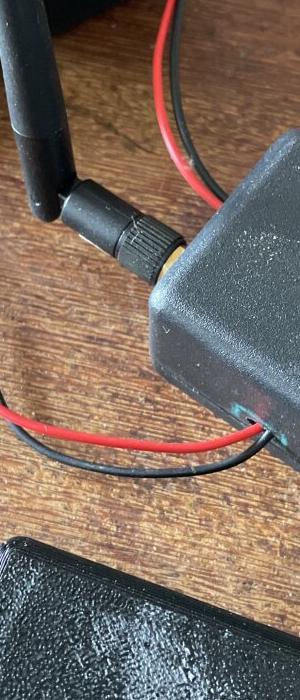
JavAlarm is a low-cost, low-power system for detecting electric fence failures: a transmitter connected to the fence captures the high-voltage pulses (in the kV range) with an analog circuit inspired by the farmers’ own fence voltmeters, and a microcontroller with a LoRa transceiver (915 MHz) sends the alert with its own acknowledgment protocol — if the receiver is offline, the transmitter retransmits until acknowledged, ensuring no voltage drop goes unnoticed. Consumption was optimized to 114 mA while transmitting and 32 mA idle, enabling weeks of autonomy on standard batteries.
Shitakiometer — autonomous greenhouse sensing
The second cycle served mushroom producers, who must track temperature, relative humidity and CO₂ concentration in their greenhouses. Shitakiometer integrates DHT22 and MH-Z19B/SCD40 (NDIR CO₂) sensors with an ESP32 platform featuring LoRa radio, deep-sleep firmware and a 5V/1.25W solar panel with an 18650 battery — targeting continuous operation with a positive energy balance.
On the backend: LoRa gateway → MQTT broker (Mosquitto) → Node-RED → InfluxDB → real-time Grafana dashboards, with alerts in the farmer’s own language (Telegram/WhatsApp).
Partnerships and next steps
The work is developed with UNIFESP undergraduate students and organizations in the daily grind of the field: the Portal Sem Porteiras Association (Monteiro Lobato-SP), Akarui (São Luiz do Paraitinga-SP) and the Apoena Association.
On the horizon: full JavAlarm integration, a weatherproof case, a bootloader with remote firmware updates, and an ecosystem of decentralized innovation combining low-power radios, lightweight protocols and harvest energy — building not only technology, but technical autonomy and digital sovereignty for rural communities.
Results — prototypes, manuals and booklets — will be released on open-access platforms and shared with the communities in person, at extension fairs and social technology forums. A first version of these stories was presented at DWeb Camp 2026, in the session Semea-tec: seeding tech, growing autonomy.